Tabelog - Food Guide in Japan
Kakaku.com, Inc.Food & Drink
4.923.00 Reviews
- Version
- 2.17.0
- Installs
- 500.00K
- Age Rating
- Everyone
Screenshots
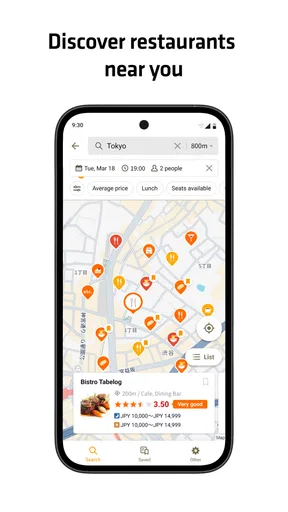
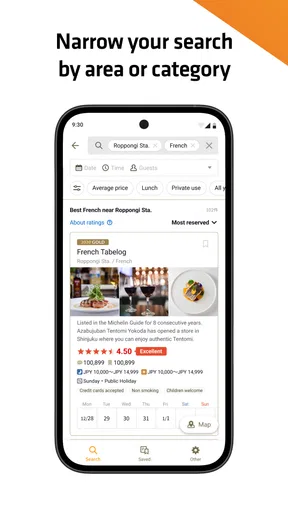
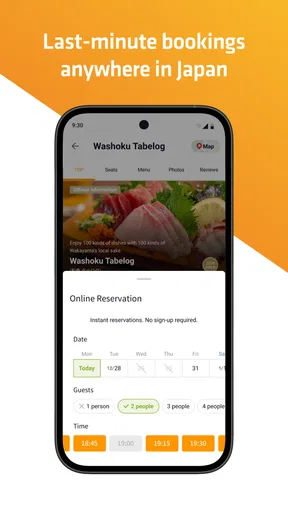
Our Review of Tabelog - Food Guide in Japan
 Analysis by Appyee
I found Tabelog most useful when I treated it as a restaurant-discovery companion rather than a general-purpose map. Its focus is Japan, and that narrow purpose gives it a different feel from the usual app I would open simply to find the nearest place serving food. It is made for people who want to explore beloved restaurants and read food guidance with a traveler’s needs in mind, especially visitors coming from the United States.
The app is free, which makes trying it straightforward: there is no purchase decision to make before seeing whether its approach suits you. It belongs to the Food & Drink category and comes from Kakaku.com, Inc. The current version is 2.17.0, and its Everyone age rating makes it approachable for a broad audience. I would still judge it by the quality of the search experience and the usefulness of its restaurant information, not simply by the fact that it costs nothing.
How Tabelog fits into planning food in Japan
My first impression is that Tabelog is aimed at a more deliberate kind of restaurant search. A map app is excellent when I already know where I am and need something close. Tabelog feels more appropriate when I am deciding what kind of meal deserves a place in my day, particularly in a country where a short walk can lead to very different dining experiences.
That distinction matters for travelers. A generic search usually produces a mixture of restaurants, chains, advertisements, tourist suggestions and places that happen to be nearby. A Japan-focused food guide can be more helpful when the question is not “What can I eat right now?” but “Which restaurant should I build my evening around?” I would use it before leaving the hotel, while comparing neighborhoods, or when arranging a meal around sightseeing.
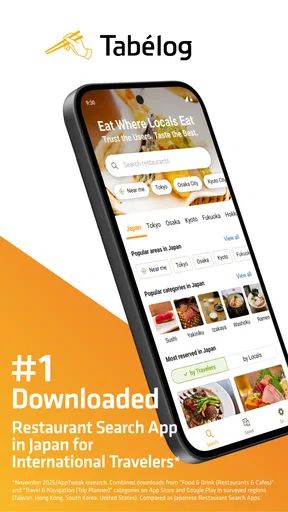
The app’s store summary points directly toward two audiences: people looking for beloved restaurants in Japan and travelers from the U.S. looking for food guides. I see that as a useful signal about its intended role. It is not trying to be a worldwide restaurant directory. If my trip is centered elsewhere, this specialization immediately reduces its value.
The app has reached over 500 thousand installs and holds a 4.9 average from around 3.6 thousand ratings. Those figures suggest that it has attracted a meaningful audience, but they should not replace personal testing. Restaurant discovery is subjective: a visitor who wants famous local food may appreciate the app more than someone who only needs the fastest nearby lunch.
What the free access means in practice
The important cost fact is simple: Tabelog is free to use. That gives it a strong starting position against paid travel guides, printed restaurant books and any service that asks me to subscribe before I can decide whether its recommendations are relevant. I can approach it as a planning tool without adding a purchase to my travel budget.
Free access does not automatically mean that every restaurant decision becomes easy. I still need to judge location, opening details, suitability for my group and whether a recommendation matches my taste. The app’s value comes from reducing the time spent searching and helping me discover candidates; it should not be treated as a guarantee that every result will be the perfect choice.
I also like the fact that the price does not force a complicated value calculation. With a paid guide, I would ask whether the content justifies its cost before using it. Here, the more practical question is whether the app saves enough planning effort to deserve space on my phone. For a Japan trip, even one useful discovery can make the free download worthwhile. For someone who rarely eats out or has no Japan travel plans, the benefit is naturally much smaller.
The kind of value it can add beyond a normal map
The strongest potential benefit is focus. A map app organizes places around geography, while Tabelog is centered on restaurants and food guidance in Japan. That can change how I plan. Instead of starting with a pin near my hotel, I can start with the meal I want and then decide whether the location fits the day.
A practical workflow is to use it during itinerary planning, not only at the moment hunger arrives. I would first identify the areas I expect to visit, then look for restaurants that fit the style of meal I want, and finally compare those options with the route for that day. This avoids a common travel mistake: choosing a restaurant because it is close, only to discover that it does not suit the timing or atmosphere I had in mind.
Another useful trade-off is the balance between discovery and certainty. A focused guide may expose me to places I would never find through a simple “restaurants near me” search. At the same time, discovery requires more judgment. I should be prepared to investigate each candidate rather than assuming the first appealing result is automatically the best option.
For travelers from the United States, the food-guide orientation may also make the app less intimidating than starting with unfamiliar Japanese restaurant terminology and local search habits. I would still expect to spend time understanding the context of each listing, but the app’s purpose is clearer than that of a broad social network or a general map service.
A realistic day-to-day travel scenario
Imagine I am spending the afternoon in a Japanese neighborhood and have a free evening. I could open a map, search for dinner and choose the closest well-reviewed result. That is efficient, but it may produce a meal that feels interchangeable with many others. With Tabelog, I would instead browse while I still have time, compare restaurants in the area and choose one that fits the kind of evening I want.
If I am traveling with a friend, the app can become a discussion tool. We might narrow the choice to several restaurants, compare how well they fit our route and decide whether a special meal is worth crossing the neighborhood for. If we are tired and simply need food immediately, the usual map app may remain the better choice because speed matters more than exploration.
This is one of the clearest lessons from using a specialist guide: it is most valuable before the decision becomes urgent. When I wait until I am hungry, short on time and standing outside a station, I care about convenience. When I search earlier, I can use Tabelog for discovery and then confirm practical details through whichever source is most convenient.
Where the experience may require patience
The Japan-only focus is both the app’s identity and its main limitation. It is a poor fit for someone who wants one restaurant app for every country. I would not install it as my primary dining tool for a multi-country trip unless Japan is a substantial part of the itinerary.
Its specialist purpose also means that it may feel excessive for very simple searches. If I only want coffee near a train station, a familiar map service can be faster. Tabelog becomes more compelling when I care about choosing among restaurants, learning about food options and planning a meal with some intention.
There is another practical limitation to keep in mind: a restaurant guide can support a decision, but it cannot remove the uncertainty of travel. Circumstances can change, a location can be inconvenient once I arrive, and a restaurant that suits one traveler may not suit another. I would use the app to create a shortlist, then check the final details before committing my evening.
I also would not confuse a high average rating with a universal recommendation. The app has a 4.9 average and around 3.6 thousand ratings, which is encouraging, but ratings describe the app’s reception rather than the quality of every restaurant I might find through it. My own preferences, budget and schedule still matter more than a single number.
Who is most likely to get real value
Tabelog is a strong match for travelers preparing a Japan itinerary, especially those who see food as part of the trip rather than a basic necessity. It should appeal to people who enjoy comparing restaurants, exploring local dining possibilities and reserving time for a meal that feels distinctive.
I would also recommend trying it to visitors who feel overwhelmed by the number of choices in Japanese cities. The app’s focused identity can make the search feel more purposeful than opening a broad map and scrolling through an endless list. It is particularly useful when the neighborhood itself is part of the plan and I want the meal to complement the day.
It may be less useful for a resident who already has a trusted local routine, a traveler who eats only at familiar international chains, or anyone who dislikes spending time researching meals. It is also not the first app I would choose for a person whose priority is turn-by-turn navigation, instant proximity or a single global restaurant database.
For families and groups, I would treat it as a starting point rather than a final authority. The person choosing the restaurant should still consider the group’s preferences, walking tolerance and schedule. A guide can broaden the shortlist, but it cannot make a shared decision for everyone.
How I would combine it with other tools
I would not force Tabelog to replace every other travel app. Its best role is as the food-focused layer of a broader planning setup. I might use it to discover candidates, a map app to understand the route, and a calendar or notes app to keep track of the meals I am considering.
This combination also reduces friction. Tabelog can help answer the “where should we eat?” question, while a map is better for “how do we get there?” Separating those jobs is more realistic than expecting one app to be perfect at discovery, navigation and last-minute logistics at the same time.
For a quick meal, I would start with the map. For a planned dinner, I would start with Tabelog. For a food-centered trip, I would browse several possibilities before traveling and keep a flexible shortlist instead of locking every meal into a rigid schedule.
My final recommendation
Tabelog is worth trying if Japan is central to your travel plans and you want restaurant discovery rather than only nearby search. Its free price removes the main financial barrier, its Japan-specific focus gives it a clear purpose, and its food-guide approach can add useful depth to itinerary planning. The app is developed by Kakaku.com, Inc., carries an Everyone rating, and its strong reception indicates that many users find the experience worthwhile.
I would skip it if I need a worldwide dining app, instant navigation or the fastest possible answer to a simple “what is nearby?” question. In those situations, a general map or travel service may be more efficient. Tabelog asks me to spend a little more time choosing, but that effort can pay off when the meal itself is part of the experience I want from Japan.
My verdict is positive, with a clear condition: use it as a planning and discovery guide, not as a substitute for personal judgment or every other travel tool. Because it is free, I see little downside in testing it before a Japan trip. If its focused restaurant search helps me find even one memorable place that a generic search would have missed, it has already delivered value without requiring a purchase.
Verdict
Strengths of Tabelog - Food Guide in Japan
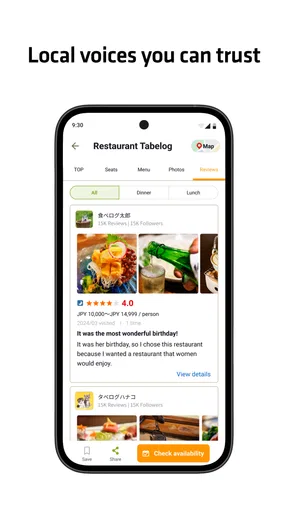
- Detailed reviews and ratings for restaurants across Japan.
- Useful filters for cuisine, location, budget, and dining preferences.
- Strong coverage of local eateries beyond major tourist destinations.
- Menus, photos, and user comments help with pre-visit planning.
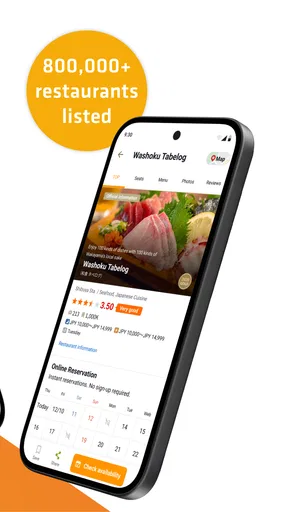
- Reservation features are available for many listed restaurants.
Limitations of Tabelog - Food Guide in Japan
- Much of the content is geared toward Japanese-speaking users.
- Some restaurant information may become outdated after changes or closures.
- Top-rated venues can be difficult to book during busy periods.
- Advanced features and reservations may require account registration.
- Coverage and usefulness vary considerably outside major Japanese cities.
Similar Picks in This Category
View All
Rappi: Food Delivery, Grocery
Rappi, Inc - Delivery3.5

McDonald’s: Cupons e Delivery
Arcos Dorados4.3

Swiggy: Food Instamart Dineout
Swiggy4.7

Blinkit: Groceries & more
Blinkit4.8

foodpanda: food & groceries
Foodpanda GmbH a subsidiary of Delivery Hero SE4.0

Zomato: Food Delivery & Dining
Zomato4.7
Frequently Asked Questions
What is Tabelog - Food Guide in Japan?
Tabelog is a popular restaurant discovery and review app focused on Japan. It helps users search for restaurants, cafés, bars, and other places to eat by location, cuisine, budget, rating, and restaurant features. The app is especially useful for finding highly reviewed local businesses, checking menus and photos, reading customer feedback, and planning where to eat before or during a trip across Japan.
Can visitors who do not speak Japanese use Tabelog?
International visitors can use Tabelog, but the experience may be easier for people who understand Japanese. Many restaurant names, reviews, menus, and booking details are primarily written in Japanese, although app features and device translation tools can help. It is worth checking addresses, opening hours, reservation instructions, and restaurant policies carefully, since automatic translations may not always explain important details accurately.
Can I make restaurant reservations through Tabelog?
Some restaurants listed on Tabelog allow users to make reservations directly through the app or website, while others only provide contact information or external booking options. Availability depends on the restaurant, date, time, and booking system it uses. Before confirming, check whether the reservation requires a phone number, credit card, deposit, cancellation fee, or Japanese-language communication.
Does Tabelog show reliable restaurant ratings and reviews?
Tabelog provides a large collection of user ratings, written reviews, food photographs, menus, and restaurant information, making it a valuable research tool. However, ratings should not be treated as an absolute guarantee of quality. Experiences can vary by location, date, service, and personal taste. Reading several recent reviews and checking photos is usually more helpful than relying only on the overall score.
Is Tabelog free to download and use?
Tabelog is generally available to download and use without paying an upfront fee, allowing users to search restaurants, view listings, read reviews, and explore food categories. Some features, such as reservations or additional services, may have their own conditions, and restaurants may charge normal booking, cancellation, or service fees. Review the details shown before completing any reservation or purchase.
